

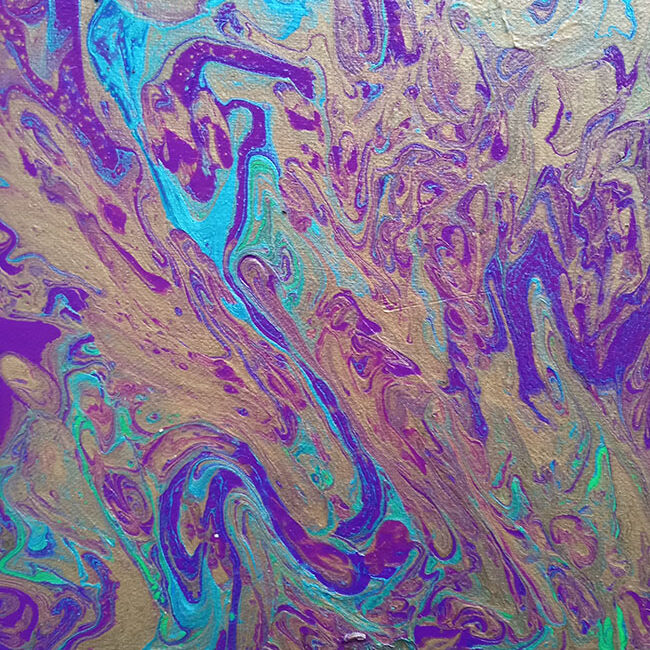
For Allan Wesaquate, painting is not a matter of fixing a single image in place, but of channeling emotional energy into something fluid—movement, color, and atmosphere that feel constantly in motion. His abstract compositions seem to breathe and shift, as if the surface is never fully settled. Through layered acrylic paint, vivid hues, and drifting forms, Wesaquate builds visual spaces that carry traces of personal experience while remaining open enough for viewers to project their own inner worlds onto them.
The painting shown here, created in 2024 in acrylic on linen, emerged from a turbulent chapter in the artist’s life. During that period, Wesaquate was dealing with repeated break-ins at his home. The experience left him feeling exposed, unsettled, and emotionally drained, as though a sense of safety had been quietly eroded. Rather than translating this situation into literal imagery, he reshaped it into abstraction. What resulted is a canvas charged with tension and instability, yet still threaded with brightness and unexpected optimism.
That duality sits at the heart of his practice.
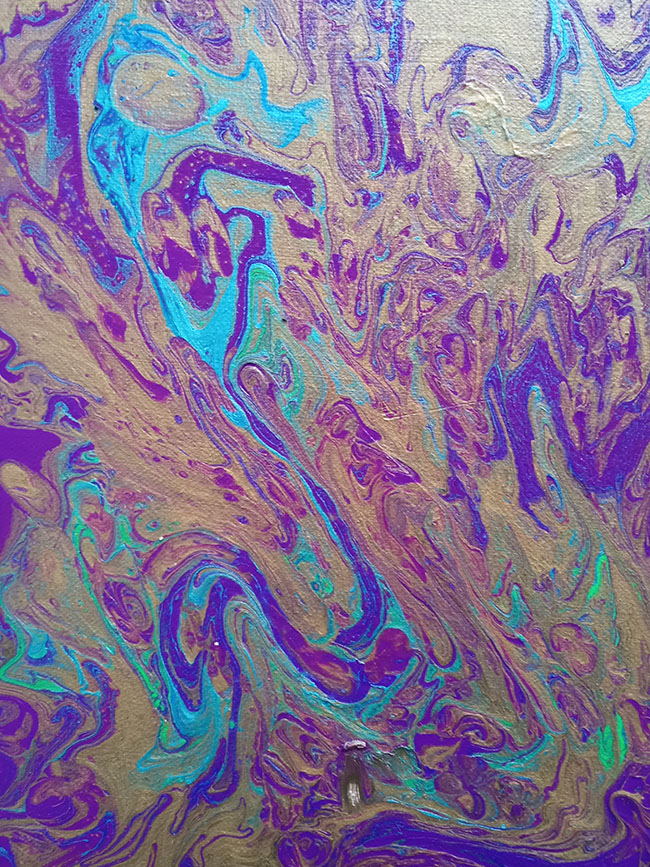
Although born from anxiety and disruption, the painting never settles into darkness. Instead, waves of electric purple, turquoise, deep blue, and gold ripple across the linen in overlapping currents. The surface feels alive with constant transformation, like thoughts forming and dissolving in real time. Shapes melt into one another, colors collide and separate again, and no single focal point anchors the viewer. Instead, the eye moves continuously through the work, as though drifting through shifting emotional weather.
Wesaquate calls this visual approach “bubblegum psychedelic,” a term he has used since around 2010. The phrase captures the tension at the core of his work. On one hand, there is a psychedelic sensibility—flowing forms, warped perception, hypnotic movement, and heightened emotional intensity. On the other, there is a playful, almost buoyant brightness that resists heaviness. The sweetness implied in “bubblegum” softens the turbulence, allowing the work to carry intensity without becoming engulfed by it.
Color plays a central role in this balance. Wesaquate often gravitates toward luminous palettes because he wants to generate a sense of uplift, even when the work grows out of difficult circumstances. Glowing turquoise lines cut through fields of purple like sudden flashes of clarity breaking through confusion. Pockets of gold and warm beige create a grounded undertone beneath the saturation, preventing the composition from tipping into emotional overload. Within the painting, conflict and calm exist side by side.
One of the most compelling aspects of the work is its refusal of explicit narrative. The viewer does not need to know the backstory of the break-ins to feel the unease embedded in the painting. Instead, meaning emerges through rhythm, density, and flow. Some areas tighten and compress with intensity, while others open into softer expanses that feel like release. This constant shifting generates a psychological push-and-pull that mirrors the lived emotional state behind its creation.
At the same time, the painting resists stillness entirely. Forms twist, loop, and drift into one another in a continuous state of becoming. The surface can feel almost geological or cosmic, as though it records emotional pressure systems rather than depicting physical objects. In this sense, the work transcends its specific origin in 2024, expanding into something more universal. Anxiety, fragility, persistence, and the search for equilibrium become readable not as stories, but as sensations.
Wesaquate has described his process as capturing “the energy of the day, not a period of time.” That distinction is central to understanding his approach. Rather than reconstructing events or illustrating memory, his paintings act as emotional registers—snapshots of internal weather rather than external circumstance.
That immediacy runs throughout the composition. Nothing feels overly controlled or rigidly planned. The paint appears to respond instinctively, guided by impulse and momentum. Yet within that spontaneity, a subtle equilibrium holds everything together. Lighter passages counter darker zones, keeping the eye in motion from edge to edge without ever settling completely.
In many ways, the painting becomes an act of transformation—turning intrusion and vulnerability into something expansive and unexpectedly vibrant. What began as a disruption is reconfigured into rhythm, color, and movement, as if the work itself is finding a way to metabolize unease into energy.
The result is an image that communicates through sensation rather than explanation. It invites viewers into a shifting emotional field where meaning is not fixed, but continually unfolding in the flow of color and motion.
Other Articles

The Story Behind Claude Monet’s Water Lily Pond