



Claude Monet’s Water Lily Pond is a quietly radiant masterpiece that distills nature into a state of near-weightless calm. Painted between 1899 and 1900, it belongs to his celebrated series inspired by the water garden at his home in Giverny, France—a space he shaped as much as he observed, turning it into a living laboratory of light, reflection, and color.
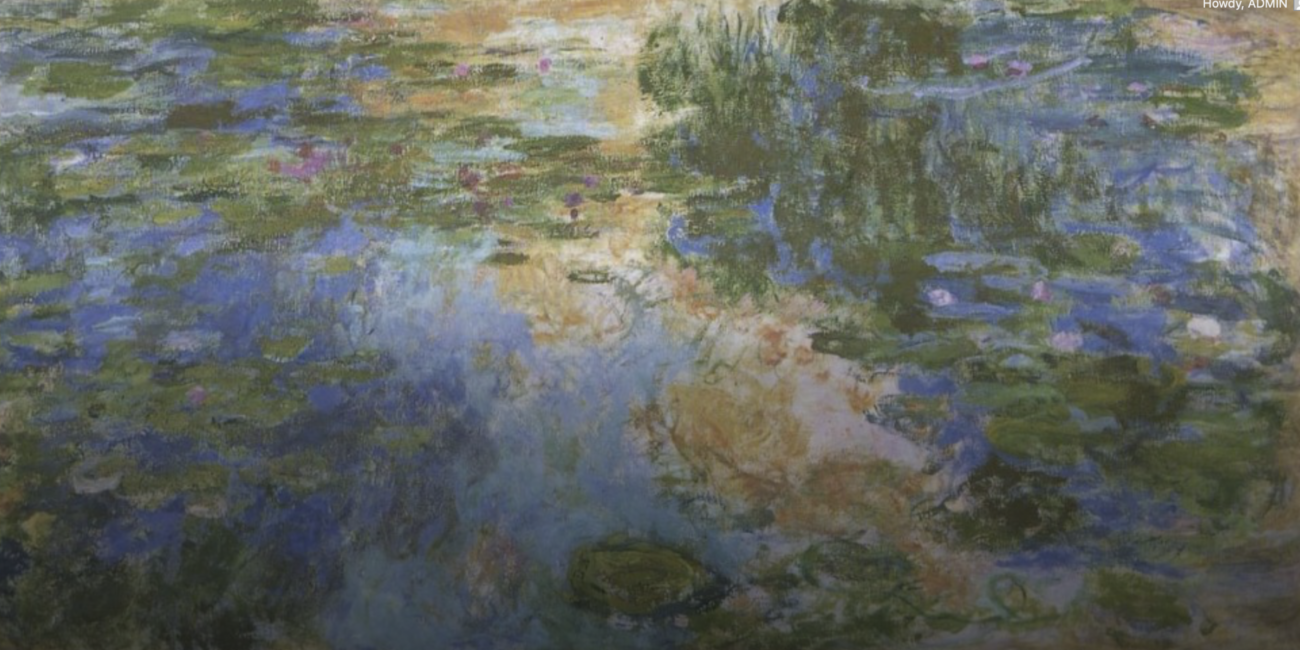
At first encounter, Water Lily Pond unfolds like a soft orchestration of color and atmosphere rather than a fixed scene. The surface seems to shimmer and breathe, held together by Monet’s loose, instinctive brushwork. His strokes do not describe so much as suggest, allowing forms to emerge and dissolve in the same breath. The result is a painting that feels less constructed than discovered, as though the garden itself briefly surfaced on the canvas.
Color carries the emotional weight of the composition. Gentle pinks and violets drift across the water lilies, while layered greens gather around them like dense, living currents. These tones do not sit still; they ripple and mingle, creating a sense of motion that feels both visual and atmospheric. Monet’s sensitivity to color turns the entire surface into a field of subtle vibrations.
At the center lies the pond itself—a quiet expanse where water becomes both subject and mirror. The lilies float like small, luminous interruptions across its surface, their rounded forms scattered in rhythms that feel natural yet almost musical. Beneath and around them, reflections blur the boundary between object and image, as if the pond is continuously rewriting what it shows.
Light is the invisible force holding everything together. It slips across leaves, dissolves edges, and softens transitions between water and sky. Instead of fixing the landscape in place, Monet captures it in a state of perpetual becoming. Shadows are not static but shifting, and highlights appear like brief, flickering moments of attention rather than permanent features.
The water lilies themselves carry a quiet symbolic resonance. They stand for impermanence—the brief, ungraspable beauty of natural life unfolding and fading in cycles. In Monet’s hands, they become more than botanical forms; they are moments suspended just long enough to be felt before they change again. This sense of transience echoes the artist’s broader pursuit of capturing perception itself rather than fixed reality.
Surrounding the pond, vegetation thickens into a living frame. Reeds and grasses lean and sway, their forms loosening into brushy gestures that echo the movement of water. Beyond them, trees gather in soft masses of green, filtering light into broken patterns that scatter across the scene. Everything feels interconnected, as if the garden is not composed of separate elements but of one continuous breath.
In Water Lily Pond, Monet moves beyond representation into something more experiential. The painting does not simply depict a place—it recreates the sensation of being within it. Time feels slowed and softened, allowing the viewer to drift rather than observe. What emerges is not just a landscape, but a state of mind shaped by attention, stillness, and flow.
As one of the defining achievements of Impressionism, the work continues to resonate because it offers more than beauty—it offers immersion. Through color, light, and gesture, Monet transforms a garden into a space of contemplation, where the ordinary rhythms of nature become something quietly extraordinary.