


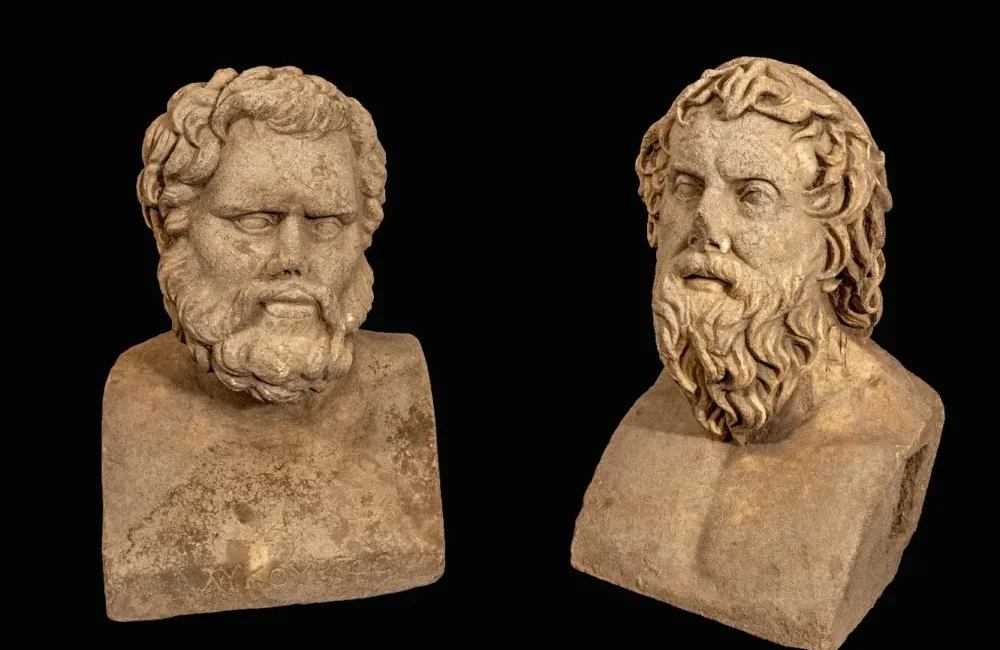
An archaeological dig carried out ahead of a planned railway expansion near Binyamina in northern Israel has led to the unexpected discovery of two remarkably preserved statues dating back to the late Roman period. The excavation was led by the Israel Antiquities Authority (IAA), which confirmed the find.
The marble busts, estimated to be from around the 4th century CE, are believed to portray notable figures from the Greco-Roman world. One of them carries an inscription reading “Lycurgus.” Dr. Peter Gendelman, an expert with the IAA specializing in the history of nearby Caesarea—a city that served for roughly 650 years as the Roman administrative center of Judea, Syria Palaestina, and later Palaestina Prima—explained that two historical figures bore that name: one the legendary founder of Sparta, the other a 4th-century BC orator. “It may be one of these figures, but the research is only beginning,” Gendelman noted.
The sculptures were found lying face down inside an empty wine-collection vat from the Roman-Byzantine era. According to the IAA, they appear to have been deliberately placed there after the winepress fell out of use. “At this stage, it is not known why the statues were hidden here, perhaps to protect them,” the authority said.
“In the Roman period, statues like these were displayed in both public spaces and the homes of the elite, who often used them to align themselves with the intellectual and cultural ideals of antiquity,” Gendelman explained. He also pointed out that a nearby bathhouse had previously been uncovered, suggesting the area may once have hosted a luxurious villa belonging to Caesarea’s upper class.
Eliran Oren, who co-directed the excavation with Avishag Reis, echoed this view. Although the statues were found within what appears to have been an agricultural installation, the presence of the bathhouse nearby points to a wealthy suburban estate linked to the ancient port city. “Another possibility,” he added, “is that they originated in Caesarea itself, roughly ten kilometers away.” In either case, he emphasized, “These are not statues that would have stood in a simple farmhouse.”
Oren noted that the sculptures appear to represent real individuals rather than symbolic or mythological figures. If one truly depicts the founder of Sparta, it would make the find especially significant, given the historical gap of centuries between the figure’s life and the statue’s creation.
According to Oren, such well-preserved statues are exceptionally rare in Israel and beyond. “This is a once-in-a-lifetime discovery,” he said alongside Reis. “The most extraordinary finds often come when least expected—and in this case, they emerged on the final day of excavation.”
Other Articles
The Story Behind Claude Monet’s Water Lily Pond
Cambridge Arts Awards $67,500 for Social Justice