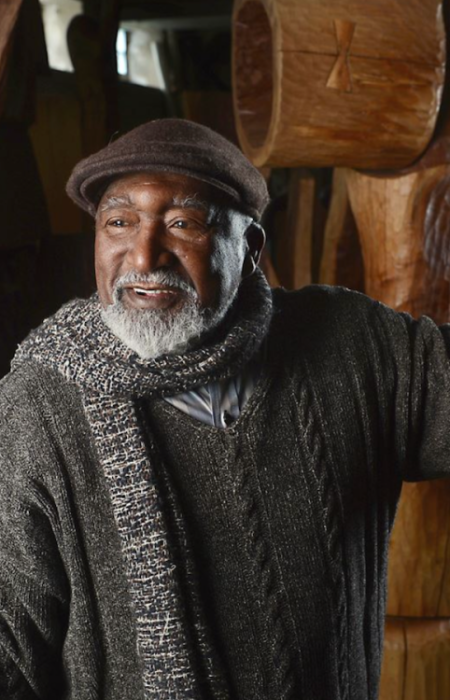



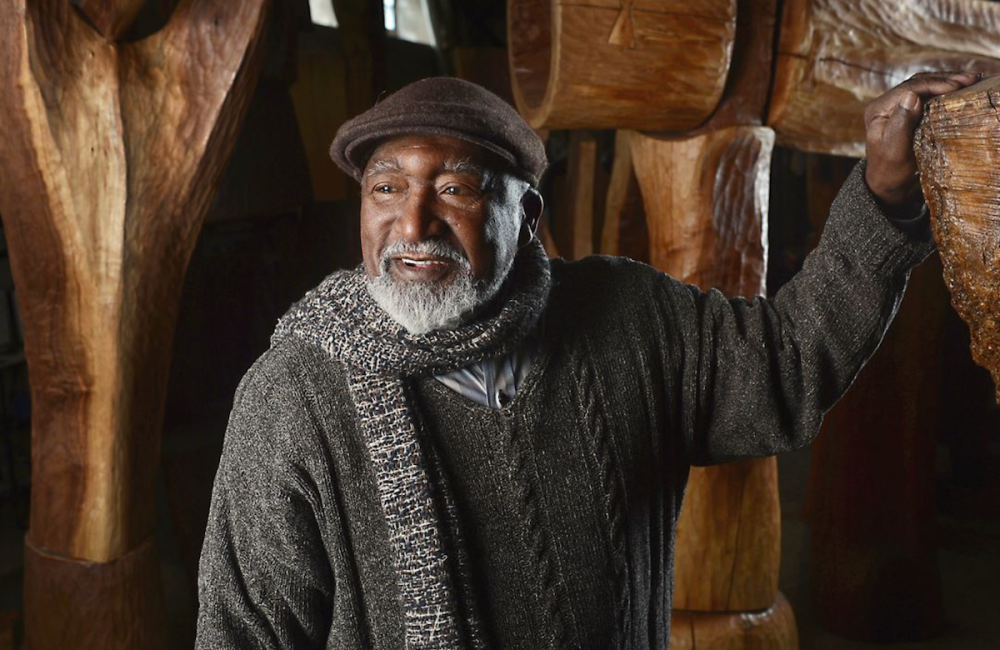
Thaddeus Mosley, a sculptor whose abstract forms—crafted from reclaimed wood—earned him a devoted and passionate following in the later years of his career, died on Friday in Pittsburgh, Pennsylvania, at the age of 99. His family confirmed his passing. His son, Pittsburgh City Councilman Khari Mosley, remembered him as “a dedicated family man, ubiquitous community pillar, and an inimitable creative force.”
Many of Mosley’s works were built from salvaged pieces of walnut, sycamore, and cherry wood, which he personally transported to his Pittsburgh studio. Working with gouges of varying sizes, he carved and shaped the timber into smooth, flowing forms, often allowing the natural grain of the wood to guide the movement of his tools. The material was never forced into submission; instead, it seemed to converse with the artist’s hand.
The resulting sculptures often weighed hundreds of pounds, yet in Mosley’s handling they appeared weightless—almost floating in space. In a 2024 conversation with ARTnews, he compared his process to judo, explaining, “You learn where the center of gravity is. A lot of the idea is based on the concept of weight in space.”
Over time, these works earned him a loyal and steadily growing audience. Long revered in Pittsburgh as a local legend, he also inspired admiration among generations of Black artists. Painter Sam Gilliam once called him the “keeper of the trees.”
However, it was not until 2018—when Mosley was featured in the Carnegie Museum of Art’s Carnegie International—that he gained broader mainstream recognition. Since then, major institutions including the Whitney Museum, the Brooklyn Museum, the Guggenheim Museum, the Seattle Art Museum, and the Baltimore Museum of Art have acquired his work.
Recent critics have praised him with renewed intensity. “Largely promoted by a community of Black writers, artists, and musicians, Mosley’s work more than holds its own with his celebrated peers,” wrote John Yau in a 2020 Hyperallergic review. “He did not need the art world’s approval to keep going, but the art world certainly needs him for more reasons than I can count.”
Unlike many sculptors working at monumental scale, Mosley labored alone for most of his career, rarely relying on studio assistants. When necessary, he used a small crane to move heavy materials. His practice remained slow, contemplative, and deeply physical—an ongoing negotiation with the wood itself. A 2025 exhibition at Karma, the New York gallery representing him, featured just 12 sculptures, created over the previous two and a half years.
In the early stages of his artistic journey during the 1950s, Mosley collected wood from fallen trees rather than purchasing it. “At first, I didn’t think much about how the tree grows; I saw it mainly as raw material,” he once told Bomb. Only later did he begin sourcing wood from local sawmills.
Even as his methods evolved, his philosophy stayed consistent. “I still try to yield the original idea, the original shape,” he said in the same interview. “Keep in mind that this is not a painting, so you can change a sculpture only so much. Even when certain segments resist fitting together, I have to find the center of gravity.”
Thaddeus G. Mosley Jr. was born in 1926 in New Castle, Pennsylvania, to a coal miner father and a seamstress mother. His childhood was shaped by frequent relocations due to his father’s work in the mines. He began school in Grove City, but the experience proved difficult, leading his mother to return with him and his siblings to New Castle. The strain of separation eventually led to his parents’ divorce when Mosley was eight.
As he grew older, Mosley decided the mines were not his future. “The mines just weren’t for me,” he later reflected in Pittsburgh Quarterly, choosing instead to focus on education. After high school, he enlisted in the US Navy, later moving to New York before settling in Pittsburgh. There, he studied English and journalism at the University of Pittsburgh, often finding himself among very few Black students in his classes. “Sure, this bothered me,” he admitted in an interview.
A pivotal moment came in 1948, when, for a world history assignment, he encountered images of Constantin Brâncuși’s work. The Romanian-born modernist sculptor’s streamlined forms—birds in flight, couples in embrace—made a lasting impression. Though Mosley did not yet know of Brâncuși’s deep engagement with African art, he sensed an intuitive connection, noting affinities between those flowing forms and Senufo bird motifs.
As his artistic thinking developed, Mosley deepened his engagement with African art, collecting masks and studying its influence on modernism. He came to recognize its foundational role in shaping European avant-garde movements. “Without West Africa,” he once said, “there would be no Cubism.”
After college, Mosley worked part-time as a sports journalist for the Pittsburgh Courier. Around the same time, he began seriously pursuing sculpture. A visit to Kaufmann’s department store in the 1950s, where he encountered Scandinavian wooden objects shaped like birds, became another spark. Thinking he could create something similar, he began carving his own wooden forms.
For decades, however, art remained a parallel pursuit rather than a full-time profession. Mosley worked for 40 years at the US Postal Service, retiring in 1992. The stability of the job gave him space to develop his artistic ideas outside working hours. “I could save all my energy, all my thinking power for my work,” he told ARTnews. He did not earn significant income from his art until his first exhibition with Karma in 2020.
His major breakthrough into the wider art world came in 2018, when he was included in the Carnegie International at the Carnegie Museum of Art—a show he had long attended as a visitor. Curator Ingrid Schaffner placed the then-92-year-old artist alongside internationally recognized figures such as El Anatsui, Lynette Yiadom-Boakye, and Alex Da Corte.
From there, Mosley’s recognition expanded rapidly, leading to larger public commissions. He began casting wooden forms into bronze and installing monumental works in public spaces, including City Hall Park in New York. In a 2025 Public Art Fund exhibition, he presented Gate III, a towering 15-foot structure resembling a skeletal portal.
Even as his public profile grew, he continued to work on intimate, delicate pieces. His recent show at Karma featured small sculptures made of glass fragments delicately balanced against one another—precarious compositions that seem poised to collapse at any moment, yet somehow remain in harmony.